


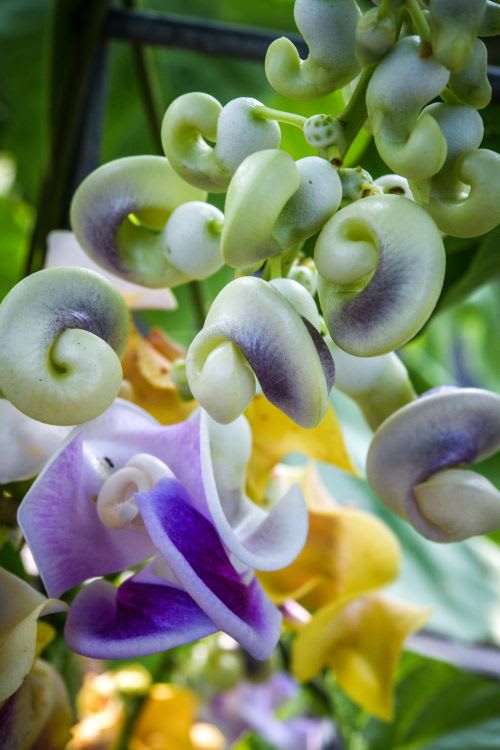
Thomas Jefferson swooned over the snail vine, calling it “the most beautiful bean in the world,” as he searched for seeds to grow in his garden at Monticello. No wonder: these shapely, fragrant blooms are mesmerizing!
Snail vine is native to Central and South America, and it blooms lavishly as a perennial in the warm tropical climate. Introduced from Brazil to Portugal in 1690, it’s believed that the plant gets its name partly from the Portuguese word for snail, “caracol.”
Snail vine goes by many names: Pet-snail vine, snail bean, snail flower, corkscrew vine and corkscrew flower. It’s also called Bertoni bean, after the Swiss botanist Moises Santiago Bertoni, who spent much of his adult life living and working in Paraguay and included the snail vine in his collection.
Snail vine’s botanical taxonomy is similarly complex, and it has evolved with scientific understanding. In 1753, Swedish botanist Carl Linneaus described snail vine as Phaseolus caracalla. Ten years later, German physician and botanist Christoph Jakob Trew named it Cochliasanthus caracalla. In 1970, Bernard Verdcourt, a biologist at Kew Gardens in Britain, reclassified it as Vigna caracalla. There are two plants you might encounter as “snail vine,” or similar names, and it’s almost impossible to distinguish them from their foliage alone.
In 2011, after further genetic studies, the name Cochliasanthus caracalla was resurrected to describe the snail vine that Baker Creek offers: the one with profusions of yellow, lilac, and white blooms and a heavenly fragrance reminiscent of hyacinth or jasmine. (The other “snail vine” isn’t so sweet. Its lavender-colored flowers aren’t fragrant and the vine is considered invasive. It’s known as Phaseolus giganteus, Vigna speciosa or Sigmoidotropis speciosa.)
Jefferson's Quest for Snail Vine
It’s possible that Jefferson first experienced the intoxicatingly fragrant snail vine in the greenhouses at Kew when he visited England in 1786, according to researchers at Monticello. Jefferson would likely have known about it: he had a copy of Philip Miller’s 1768 edition of The Gardener’s Dictionary, which described snail vine as “a kidney bean with a twining stalk,” and further observed that it was “very common in Portugal, where its inhabitants plant it to cover arbors and seats in gardens … and highly esteemed for its sweet smelling flowers.”
In 1792, as Jefferson was serving as the nation’s first Secretary of State, he wrote to his seed supplier Benjamin Hawkins about his longing to grow snail vine in the gardens at Monticello. (Hawkins, a plantation owner and notorious slave trader from eastern North Carolina, had also tried to help Jefferson send Venus Fly Traps to Madame de Tessé, whom Jefferson had befriended during his time as minister to France in the 1780s.)
It’s not known whether Jefferson ever managed to acquire snail vine seeds, but by the late 1830s, they were being grown in American gardens. In his 1839 edition of The American Flower Garden Directory, seedsman Robert Buist wrote that “snail-flower is a very curious blooming plant, with flowers of a greenish yellow, all spirally twisted, in great profusion when the plant is well grown.” The snail flower, as it was often known, became a fashionable offering in seed catalogs of the later 19th century. Nurseryman Peter Henderson noted that florists of the Victorian era favored the fragrant, delicate blooms for their resemblance to orchids.

How to Grow Snail Vine
By the early 20th century, though, the old-fashioned tropical vine had begun to fall out of favor in American gardens, and now it is hard to find. Though the seeds are edible, they are very slow to form, and terribly bland, so most gardeners grow snail vine for its shapely, fragrant flowers.
Snail vine is perennial in zones 9 to 11, it is typically grown as an annual in areas that experience frost. At our Missouri farm, it bloomed profusely over a long season. The hard seed coat can make germination a bit tricky, so nick them and soak them in warm water for 24 hours before planting. You should start them indoors six to eight weeks before last frost, sowing them twice as deep as the seed is big. Set the transplants out after last frost. These vines do best in full sun or filtered shade and late spring or cool-summer conditions. They can grow over 10 feet long in a single summer, so give them a place to climb and show off their singular spiral shape and incomparable fragrance!
Key Takeaways
- Snail vine is a tropical perennial native to Central and South America.
- Its botanical name has changed through history, as botanists learned more about it and other related species.
- Thomas Jefferson searched relentlessly for seeds of this vine, though it is not known whether he ever managed to grow them at Monticello.
About the Author
Michelle Johnson is a nationally award-winning writer and editor with decades of experience in print, digital, and broadcast media. She is also Baker Creek's unofficial seed historian and loves the fascinating back stories of heirloom and historic seed varieties.


