


Depending on your point of view, superhot peppers are either Satan’s handiwork or a devilish means of achieving a hurts-so-good endorphin high.
People have been eating and enjoying hot peppers for thousands of years, of course, and they are an essential ingredient in many global cuisines.
But the extreme sport of breeding superhot peppers is a relatively recent phenomenon, with breeders such as Ed Currie, who developed the Carolina Reaper and its successor as the world’s hottest pepper, Pepper X (nearly twice as hot as the Carolina Reaper), pushing the humble Capsicum to its limits.
Beyond Bragging Rights: The Uses of Superhot Peppers
Superhot peppers aren’t just fodder for self-harm; they also contain various amounts of the medicinally useful compound capsaicin.
Chilies have a long history of medicinal use; in traditional Maya medicine, capsicum peppers are a remedy for asthma, coughs, and sore throat. Aztec medicine treats toothache with a hot pepper pod and salt, a remedy that continues in some places today. The pharmaceutical industry has long used capsaicin in creams and liniments for pain relief. Research shows that capsaicin holds promise in fighting certain kinds of cancer, including colon cancer and leukemia. Many people tout chili peppers’ overall health benefits, and some science seems to bear this out. For example, a 2015 study in the British Medical Journal found that people who ate spicy food every day were less likely to die of cancer or diabetes.
In the late 1990s, researchers identified the ‘capsaicin receptor’ in the human body -- TRPV1, or transient receptor potential vanilloid 1 ion channel. Understanding this mechanism, which functions as a pain sensor, may lead to the development of more effective pain relievers that target TRPV1.

Beyond their capsaicin content, superhot peppers are also valuable sources of vitamins A, C, and B6, as well as minerals such as magnesium, potassium, and copper.
A Brief History of Hot Peppers
Chili peppers are a global crop with roots in the ancient world of the Americas. Christopher Columbus took them back to Spain in 1493, but it was Portuguese explorers who planted the worldwide spread of chilies when they carried seeds from Brazil to India a few years after Columbus.
According to researchers at the Chile Pepper Institute of New Mexico State University, peppers originated in the lowlands of Brazil as “small red, round, berry-like fruit,” like the Chiltepin, a wild species that grows still in the borderlands of the U.S. and Mexico.
Researchers have uncovered archeological evidence of chilies’ use 6,000 years ago in southwestern Ecuador, finding starch grains of Capsicum on milling stones and cookpots.
Birds were essential to chilies’ spread; they snacked on the berry-like fruit and passed the seeds. (Unlike humans and other mammals, birds are impervious to chilies’ heat.)
The culinary importance of peppers is indelibly embedded in Mexico’s history. In the Florentine Codex, written shortly after the Spanish invasion of the Aztec Empire in the 16th century, Franciscan Friar Bernadino de Sahagún described several types and preparations of chile peppers at an Aztec market: fresh pods, chipotles (smoked dried chiles), and moles (sauces using a variety of chiles).
The Codex describes at least six types of chile peppers — and one of them was definitely the “jalapeño” type. The Aztec knew it as the “tornalli chilli” (summer chile) in their native Nahuatl language.

Chilies had many other uses beyond cooking, though. The Aztec also used them to pay tribute to dignitaries, a custom that the Spanish invaders kept up for practical reasons. Long before pepper spray, Aztec moms threw chili powder in the kitchen firepit and made their kids inhale the pungent smoke as punishment. The forebears of the Aztecs — the Toltecs, who vanished in the 12th century AD — thrived on trade and agriculture. They developed sophisticated farming techniques such as terraces, irrigation from a network of small dams and channels; and the unique “chinampas,” floating gardens built on swamps. Their staple crop was corn, but they also grew beans, squash, avocados, tomatoes, amaranths, dahlias, and chiles.
Today, about a quarter of the world's population eats chilies daily.
Our Hottest Hot Peppers
Death Spiral:
The Death Spiral, also known as Death Pepper, is a member of the Capsicum chinense family, and it’s a fairly new arrival on the superhot scene.
Jim Duffy of Refining Fire Chiles noticed a variant of the Naga Bubblegum Red chili growing among his plants in 2016. He saved the seeds, grew them in isolation to prevent cross pollination, and achieved the same results in several generations. Duffy named and released the Death Spiral pepper after the 2017 growout.
The Death Spiral features a similar bumpy, wrinkly skin, but the calyx — where the stem joins the pod — remains green, unlike on the Naga Bubblegum Red.
Chilies get their heat from the alkaloid compound capsaicin. In its pure form, capsaicin is a yellowish liquid, and you can sometimes see the yellow veins in a pepper and guess how hot it will taste.
In most peppers, the capsaicin is concentrated in the seeds and pith, so removing them tames the heat. Not so in superhots like the Death Spiral. Researchers at New Mexico State University found that these peppers pack as much heat in their flesh as in their pith and seeds.
Death Spiral clocks in at about 1.3 million Scoville Heat Units (SHU) – about 400 times hotter than a jalapeno!
In 1912, American pharmacist Wilbur Scoville devised a way to measure the amount of heat-producing alkaloids in chilies.

The Scoville Organoleptic test involved distilling dried chili pepper in alcohol, then diluting it in sugar water until trained testers couldn’t detect the heat. The greater the dilution, the higher the number of Scoville Heat Units. High-performance liquid chromatography has replaced human tasters, making the measurement more precise and consistent.
Death Spiral peppers change color as they ripen, from light green to peach, then orange and finally red. Their ends are pointy, and they can develop tails as well. The flavor is floral and fruity, with an upfront burn that’s hotter than most Naga type peppers. The plants grow to over four feet tall, and the fruit shape and size may vary quite a bit.
Apocalypse Scorpion:
This gnarly Capsicum chinense was developed in Italy by the AIASP, a group of breeders focused on developing superhot pepper varieties. AIASP released the seeds in 2015 in an effort to raise money for its seed bank and studies.
AIASP’s other developments include the ominously named "Genghis Khan Brain."
Apocalypse Scorpion clocks in at between 1.3 million and 1.6 million Scoville Heat Units, and though it was bred to have floral and fruity notes, the heat overpowers those flavors for most tasters.
Bhut Jolokia (Red Ghost):
Bhut Jolokia (C. chinense) is native to the northeastern states of India, where it has been cultivated for generations and has a multitude of uses, from medicine to deterring elephants! In 2007, this superhot pepper with a Scoville rating of 500,000 to 1 million was certified by the Guinness Book of World Records as the world’s hottest pepper. (It has since been dethroned and may seem even mild in comparison to varieties such as Pepper X, with an SHU of nearly 2.7 million.)
Its name means ‘Bhutanese pepper,’ or ‘ghost pepper,’ in Assamese, a language spoken in many parts of northeast India. Bhut Jolokia starts slowly but eventually makes tall plants, exceeding 4 feet in favored locations. The thin-walled, wrinkled, pointed fruit reaches 2 to 3 inches in length, ripening mostly to red. Jay’s Peach Bhut Jolokia is a fetching pale peach color, but don’t let that fool you! Its heat can also reach 1 million on the Scoville scale, making it top notch for nuclear hot recipes and sauces.

Chocolate Seven Pot:
If it’s true that ‘the darker the color, the hotter the pepper,’ then you’d be well advised to watch out for this warm-toned superhot that can reach 1.8 million on the Scoville scale! Chocolate Seven Pot originally hails from Trinidad, where hot peppers are a daily part of life. These peppers are said to get their name because one pepper can easily spice seven pots of soup!
Chocolate Trinidad Scorpion:
A cocoa-colored twist on the classic Trinidad Scorpion, Chocolate Trinidad Scorpion is extremely hot, with a heat ranking that ranges from 1.2 million to 2 million SHU! The small, wrinkled 2-inch fruit grows prodigiously. And while it is scorchingly hot, Chocolate Trinidad has a less acidic flavor with smoky undertones and hints of early sweetness.
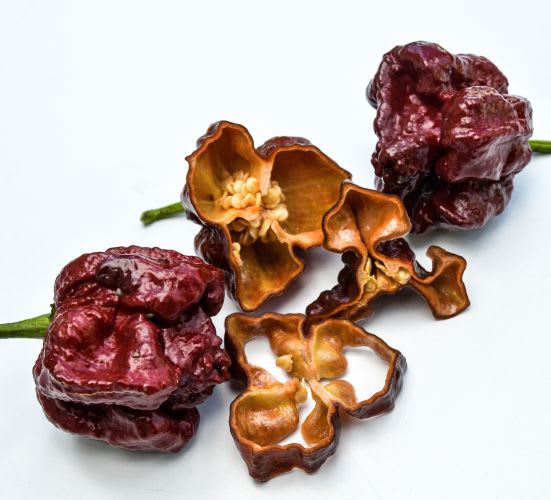
Leviathan Gnarly Scorpion Caramel:
Perhaps the most ornamental superhot pepper with lovely caramel colored skin and fascinating shape. The heat of Leviathan Gnarly Scorpion Caramel pepper ranges from 650,000 to 1 million Scoville units. The fruit grows on ornamental plants 18 to 30 inches tall. Approach with care!
How to Grow Superhot Peppers
- Hot peppers love tropical conditions. Heat and light are their friends.
- Pepper seeds can be a bit challenging to germinate. However, once established they will flourish in most gardens with little fussing.
- Start seeds indoors eight to 10 weeks before the last frost date. It can be helpful to provide a source of bottom heat, such as an electric seed-starting heat mat, to encourage germination. Hotspots around the house, such as on top of the refrigerator, can also work well.
- Sow seeds ¼ inch deep.
- Use fresh seed starting mix that is light, fluffy, and well-draining. (We like Royal Gold potting mix.) Or make your own with a blend of coco coir, perlite, and vermiculite.
- Keep the seed starting mix moist but not sopping wet; water from the bottom or mist the plants and consider using a humidity dome until the seedlings appear.
- Grow them under good light or in full sun.
- In good temps (80- 85 F), seeds sprout promptly.
- Plant your peppers outside after the soil reaches about 70 degrees. Plant them in full sun. Plant them in loose , well-draining soil. Peppers don't like excessive amounts of water.
- Fertilize them regularly with a complete fertilizer. If they stop producing peppers then give them another feeding of low nitrogen, high phosphorus fertilizer.
- Grow peppers a little on the dry side after they begin setting fruit, as this will concentrate the alkaloids that make them hotter.
- Peppers should continue to produce fruit until frost.
For more tips, see our hot pepper growing guide.

Key Takeaways
- Peppers are an ancient crop believed to have originated in the lowlands of Brazil.
- About one-quarter of the Earth's population eats chili peppers daily!
- Superhot peppers contain varying amounts of capsaicin, the alkaloid compound that accounts for their heat. In its pure form, capsaicin is a yellowish liquid that can sometimes be visible in the veins of superhot peppers.
- Hot peppers thrive in tropical conditions,and they love sun and heat. Dialing back on watering after the plants begin to set fruit concentrates capsaicin, making the fruit hotter.
About the Author
Michelle Johnson is a nationally award-winning writer and editor with more than two decades of experience in broadcast, print, and digital journalism. Her favorite job at Baker Creek is that of 'seed historian,' researching the stories of these historic varieties and the people and communities who have stewarded them.


