


Wilmatte Porter Cockerell and her husband traveled the world, enthusiastically collecting and documenting hundreds of species of insects. But her most exquisite find came on a busy roadside close to home, blooming in a spot most others would have overlooked.
Who Was Wilmatte Porter Cockerell?
Born in Leon, Iowa, Wilmatte moved to Sante Fe, New Mexico after graduating from Stanford University in 1898. Two years later, she met her husband, Theodore, when she began working at New Mexico Normal University, now New Mexico Highlands University, where they both taught biology. A self-taught entomologist from England, Theodore Cockerell was one of the most prolific taxonomists in history, publishing descriptions of over 9,000 species. The couple frequently went on collecting expeditions together and often collaborated on scientific research and writing.
In the summer of 1910, during an afternoon stroll, Wilmatte noticed an unusual red-colored sunflower in a stand of wild sunflowers growing along the roadside near their new home in Boulder, Colorado. Deciding that this remarkable bloom might not be safe alongside such a busy road, she dug up the unique sunflower and took it to her garden where she could keep a better eye on it. This red sunflower was very different from any of the other sunflowers growing along the roadside in Boulder, or anywhere else for that matter.
Wild-growing sunflowers are of the genus Helianthus, a group that comprises around 70 species, all of them native to North and Central America. Sunflowers are typically tall-growing annuals that offer attractive displays of bright yellow petals and florets. The red-colored flower that Wilmatte had discovered was known as a “sport,” a spontaneous genetic mutation, and one of a kind.

Breeding the Red Sunflower
Since wild populations of sunflowers are typically self-incompatible, meaning that more than one flower is required in order to produce seeds, Wilmatte Cockerell knew that she would need to introduce pollen from a second sunflower if she wished to propagate this unusual discovery for future generations to enjoy.
Thanks to the rediscovery of Gregor Mendel’s work only 10 years prior, she understood the necessary steps to properly propagate and stabilize the traits of her beautiful red sunflower.
Mendel was an Augustinian monk who had studied plant genetics and experimented by cross-pollinating and observing common garden peas. Mendel was ahead of his time, yet his discoveries languished in the shadow of Charles Darwin for a generation until three scientists independently verified his experiments in 1900. Mendel’s discoveries have become the foundation of our modern understanding of heredity, earning Gregor the posthumous title of the “father of modern genetics.”
Initially, Cockerell knew that she needed to cross-pollinate two of the sunflowers by introducing pollen from a common, yellow-petaled flower to her special red-colored blossom. At the end of the season, she would then harvest the mature seeds produced by her unique bloom. The following season, these seeds would produce a mix of genetics, expressed in her garden as both yellow- and red-petaled flowers, leaving her the task of selecting and saving seeds from the most red and beautiful specimens.
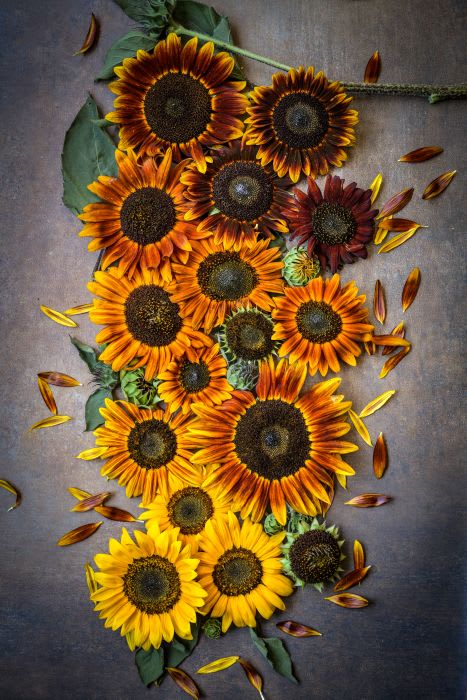
Within a few growing seasons, she had stabilized the gorgeous red color of this new sunflower, and it was ready to be shared with the world. Theodore Cockerell reached out to the Sutton & Sons Seed Company of Reading, England, which became the first to introduce the “New Red Sunflower” commercially in 1914. By the next year, a number of other retailers had picked it up, too. Morse’s Garden Guide of 1915 stated that “the long slender stems and the graceful poise of the flowers with their varied coloring, make them very effective and desirable for vasing.”
That same year, the Cockerells were awarded a medal for their work on these unique sunflowers at the Panama–Pacific International Exposition in San Francisco. These amazing sunflowers were so prized for their novelty that in 1916, Burpee offered a blend of red sunflower seeds as a free gift to their customers as a 40th anniversary promotion. Cockerell grew some of the seeds herself; others were produced at Burpee’s Fordhook Farm. Customers also received a copy of her essay about finding and breeding the plant.
Theodore Cockerell wrote in a journal article that “today, the red sunflower may be found in gardens in Europe and America, and even in Australia, New Zealand and South Africa, all the plants being descendants of the single wild sport which appeared at Boulder in 1910.” For this we owe a debt of gratitude to Wilmatte Porter Cockerell and her dedication to preserving nature’s diversity for all to enjoy!
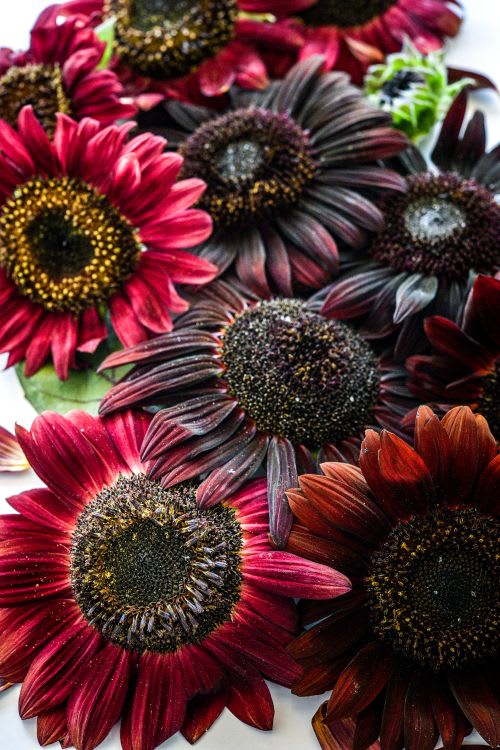
Baker Creek Heirloom Seed Company continues the story of the red sunflower with a dazzling selection of Helianthus varieties, including the gorgeous Evening Sun, the wonderful Autumn Beauty, the small but mighty Paquito Yellow and Red, Floristan, and even the decadent and delightful Chocolate Cherry sunflower.
And Baker Creek's plant breeding team continues the tradition of exploring the range and versatility of red sunflowers with their work on a fully double red sunflower. Watch this video to learn more!
Key Takeaways
- Wilmatte Porter Cockerell found a red sunflower blooming in a stand of wild sunflowers near her home in Boulder, Colorado, in 1910.
- It was a 'sport,' a spontaneous genetic mutation, and it was a one-of-a-kind flower.
- Cockerell, a biologist by training, set about trying to propagate and stabilize the red sunflower, eventually succeeding. In 1914, Sutton & Sons Seed Company of Reading, England, was the first to introduce the "New Red Sunflower" commercially.
- Cockerell's work formed the foundation of creating the many splendid red sunflowers we enjoy today!
About the Author
This story was written by Bevin Cohen for an edition of The Whole Seed Catalog. Bevin is a seed saver, teacher, author, and herbalist. He is the co-founder of Small House Farm in Sanford, Michigan, and the Michigan Seed Library Network.


