


Manpukuji carrots are so long, sweet and treasured that the farmers around Kawasaki, Japan hold tasting parties after harvest to honor the farmer who grew the most delicious ones!
Yet these elegant roots nearly disappeared under the pressures of urbanization and changing tastes.
The History of Manpukuji Carrots
Carrots were first cultivated as a food crop in Central Asia in the 10th century AD. Kublai Khan brought carrots to China around 1300 AD, and they spread to India and Japan between the 14th and 17th centuries. Unlike the orange — or carotene — carrots that are dominant today, these roots were purple, purplish-red or yellow.
Orange carrots were originally selected from yellow ones, and while Dutch breeders began selecting for the color in the 16th century, there is evidence that they have been around much longer than that. The first reference to an orange carrot came in 512 A.D. in the Juliana Anicia Codex, an illustrated version of the De Materia Medica of Pedanius Dioscorides, a five-volume treatise describing the medicinal properties of more than 600 plants. A complete sequencing of the carrot genome determined that a mutation causing the orange color appeared in the days of the Roman Empire. The Romans believed carrots were an aphrodisiac, and they were largely relegated to the pharmacopeia rather than the dinner table.
Eastern, or Asiatic, carrots are often called “anthocyanin” carrots because they contain the phytochemical that gives many fruits and vegetables their red or purple, and sometimes nearly black, hue.
In Edo period Japan, extremely long, slender Asiatic carrots like the Takinogawa were the norm, in part because they could be stored so efficiently. This traditional carrot gets its name from Takinogawa village, in the Kita-ku district north of Tokyo. Now a suburb of Tokyo, the deep, rich soil of the area was perfect for growing long-rooted vegetables, including burdock.
Beginning early in the Meiji period, shorter, easier-to-harvest European varieties started to take hold in Japanese fields. Breeders also began crossing Western carrots with Asian ones.
The Manpukuji, or “Manpukuji oonaga” (a word that translates basically as “long”) was the result of such breeding, derived from a cross between the Takinogawa oonaga and the Western-type Sapporo oonaga cultivar.
In the 1930s, these carrots grew abundantly in fields around Manpukuji Temple, a Buddhist temple and Shinto shrine near Kawasaki City, outside Yokohama. In 1949, they were registered as an official agricultural varietal and proclaimed as “the best carrot in Japan.”
But rapid urban growth in the 1950s made Japan’s “best carrot” into the “disappearing carrot.”
Its progenitor, the Takinogawa, was suffering a similar fate, and for a time was thought to be extinct. Turns out it was being reincarnated!
In 1999, a local group called the Manpukuji Carrot Friends’ Association formed to revive the cultivation of this local carrot variety.
Manpukujis are carrots with a fan club, and once you taste them, you’ll understand why!

How Long Can Manpukuji Grow to Be?
For the last several years, the horticulturists at Baker Creek have been trying to 'one up themselves' (in the words of Senior Horticulturist Andrew Miano) when it comes to growing Manpukujis.
A few years ago, the gardeners devised a growing experiment that involved planting carrot seeds in 4-foot sections of 12-inch corrugated plastic tubing. They filled the tubes with growing media (potting soil, perlite, and sand) in various proportions to see which one performed best and mounted the tubes to the wall of our 14,000-square-foot Chinese pit-style greenhouse. (A ratio of 75 percent potting soil to 25 percent sand or perlite was best, they report.)
Once the carrot seedlings were established, the garden crew thinned them to 6 to 8 inches apart, leaving three or four carrots to grow in each tube.
Manpukuji carrots prefer cool weather for growing (they will bolt in heat), and they need four to six months to mature to "ginormous" size, Andrew says. In 2025, the team planted seeds in early October and plans to harvest in April 2026.
Their techniques have evolved with experimentation, and today the garden team grows a few root crops -- Manpukuji, Moriguchi daikon radish, and burdock -- in slender six-inch by six-inch square wooden boxes -- some as tall as 10 feet -- with removable panels for ease of harvest. Andrew says they've found that growing a single carrot in a smaller, taller box yields better results.
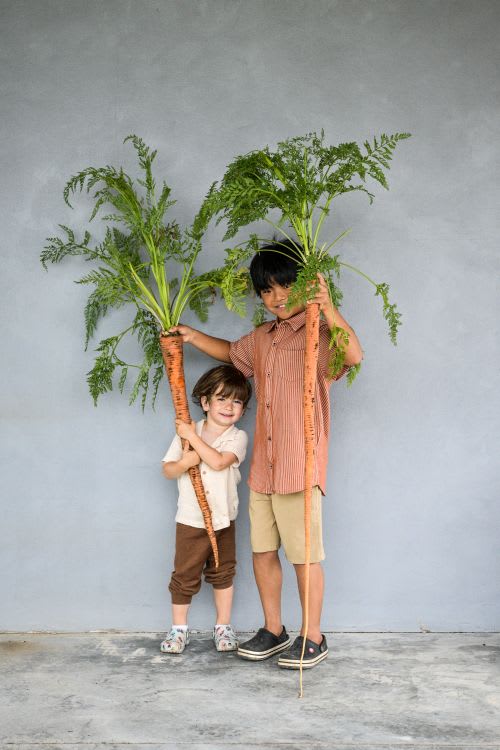
The longest carrot so far grew to just over five feet, but Andrew says the goal is to grow a 6- to 8-foot-long one!

Key Takeaways
- Carrots were first cultivated as a food crop in Central Asia in the 10th century AD.
- In Edo period Japan, extremely long, slender Asiatic carrots like the Takinogawa were the norm, in part because they could be stored so efficiently.
- The Manpukuji, or “Manpukuji oonaga” (a word that translates basically as “long”) was derived from a cross between the Takinogawa oonaga and the Western-type Sapporo oonaga cultivar.
About the Author
Michelle Johnson is a nationally award-winning author and editor with decades of experience in broadcast, print, and digital journalism. She is Baker Creek's unofficial seed historian, researching the history of heirloom varieties and the people and communities who have stewarded them.


